Reducing impact from maintenance and service
Schindler aims to reduce GHG emissions from the fleet of vehicles required for the installation of its products and the servicing of its portfolio. As a result, Schindler has been implementing GHG reduction measures. Examples include: switching to low-carbon emission vehicles, investing in charging stations at Schindler sites, investigating alternatives to cars such as public transport and e-cargo bikes for city centers, deploying eco-driving trainings, and rightsizing vehicles. In 2024, Schindler also developed a fleet-management planning tool that facilitates both estimating future costs associated with the ecological transition of its global vehicle fleet and making informed decisions to meet its commitments to reduce GHG emissions. The tool includes a hypothetical value for internal carbon pricing applied to the emissions of fossil fuel vehicles. In addition, Schindler is constantly optimizing spare parts, materials, and tools delivery to minimize trips.
Schindler has continued to deploy digital tools introduced to scale up advanced adaptive maintenance and remote services that can reduce the number of maintenance visits. In 2025, Schindler increased the share of connected units compared to its total maintenance portfolio of elevators, escalators, and moving walks by 10% compared to 2024.
In 2023, Schindler introduced a low-carbon service contract in Germany that leverages digital monitoring to significantly reduce the need for on-site elevator maintenance visits. This service minimizes the carbon footprint of maintenance activities, with TÜV Rheinland certifying a 99.5% reduction in emissions compared to traditional physical service visits. In 2025, the offering was extended to Austria, where TÜV Rheinland confirmed a 86.32% reduction in CO₂ emissions compared to traditional physical service visits. The reduction potential varies across markets and respective regulations regarding mandatory physical inspection.
In 2025, Schindler achieved its goal of sourcing and using 100% renewable electricity, partially by purchasing EACs, for its operations (scope 2 GHG emissions) in accordance with RE100 criteria in all locations where technically feasible.4 Measures undertaken to advance Schindler’s transition include: on-site generation of renewable electricity by investing in the installation of solar panels on Schindler buildings, entering into long-term power-purchasing agreements with renewable-energy project developers, recommending energy efficiency clauses to be included in lease contracts, using a selection of green electricity products from local utilities, and purchasing EACs.
In 2025, Schindler installed a Battery Energy Storage System (BESS) at its headquarters in Ebikon, Switzerland, to complement the photovoltaic system that supplies over a third of the headquarters’ annual energy needs. This large-scale energy storage solution helps stabilize the power grid and strengthen supply security.
Eleven Schindler production sites have implemented energy management systems and received ISO 50001 energy management certification – an increase of four sites compared to 2024.
Besides eliminating emissions from Schindler’s own operations, the Group strives to reduce emissions throughout its value chain (scope 3 GHG emissions). Schindler assesses all its relevant sources of scope 3 GHG emissions. These include, by order of magnitude of CO2 emissions: (i) use of sold products, (ii) purchased goods and services, (iii) upstream transportation and distribution, (iv) employee commuting, (v) business travel, (vi) end-of-life treatment of sold products. A hypothetical internal carbon price on the emissions of business flights has also been applied for selected departments to raise awareness about climate change.
As a leading provider of mobility solutions, Schindler continuously invests in energy efficiency, while also tackling the embodied carbon in its products. Examples include: investigating features to reduce standby energy consumption, switching to more energy-efficient components and to low-carbon and recycled materials, reducing material weight through design, promoting the repair and reuse of components, and strengthening sustainability-focused partnerships with suppliers.
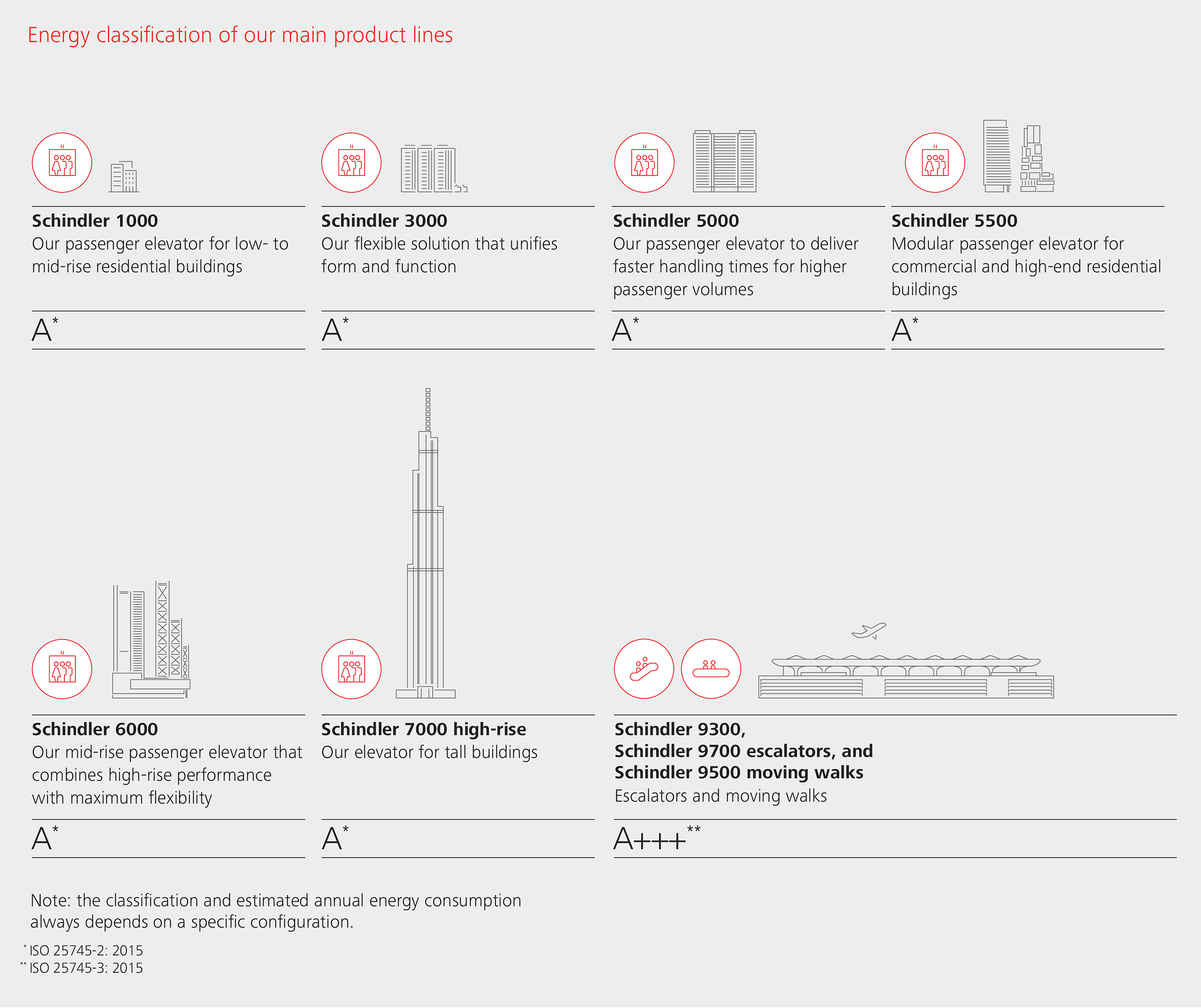
Schindler’s modular elevators (1000, 3000, 5000, 6000) and high-rise elevators (Schindler 7000) as well as selected XJ Schindler elevators (cargo lift VT-XZ-5T, cargo lift VT-XZ-10T, SL6000) and Volkslift Schindler elevators (VE2, VHW 5000), depending on configuration, can achieve a Class A energy efficiency rating according to ISO 25745-2:2015, the latest international standard for the energy performance of elevators. Schindler’s escalators and moving walks, as well as selected XJ Schindler escalators (ESP), depending on configuration, can achieve a Class A+++ energy efficiency rating according to ISO 25745-3:2015, the latest international standard for the energy performance of escalators and moving walks.
4 The calculation of the percentage excludes electricity consumption in South Korea, as Schindler completed the divestment of its South Korean operations during 2025. In countries where it was not technically feasible to source renewable electricity in line with RE100 criteria – due to limitations such as the absence of EACs in the national market – Schindler procured EACs from adjacent markets. These exceptions accounted for 0.2% of Schindler’s total electricity consumption, excluding South Korea’s consumption. As a result, in 2025, 99.8% of Schindler’s electricity consumption within this boundary was sourced in accordance with RE100 criteria. For clarity and consistency in reporting, this figure was rounded up to 100%.
Environmental Product Declarations (EPDs) provide information about environmental impact over the full life cycle of a product and are recognized by green building certification schemes, such as LEED, DGNB, and BREEAM. These EPDs can help Schindler’s customers obtain environmental building certifications. Several Schindler products are also certified under Singapore’s Green Mark product certification scheme. Schindler has EPDs for selected elevator lines (Schindler 1000, Schindler 3000, Schindler 3300, Schindler 5000, Schindler 5400, Schindler 5500, Schindler 6000, Schindler 7000, and Schindler X8), and for all Schindler escalator lines (Schindler 9300 and Schindler 9700), as well as for the Schindler 9500 moving walk line.
Schindler has also registered Health Product Declarations (HPDs) for its escalator and moving walk lines and Schindler 5500, which detail the material content of its products and their associated potential health effects.
For existing buildings, modernization can improve the energy efficiency of the original elevator or escalator by using technologies developed for new generations of products.
In addition, Schindler’s MetaCore solution enables the repurposing of existing buildings and thereby decreases the need for demolition and reconstruction, which helps to reduce the carbon footprint of the building industry.
Moreover, through the subsidiary BuildingMinds, Schindler offers real estate owners and managers a Software as a Service (SaaS) platform to take data-based decisions to drive reduction in GHG emissions.