1.3 Governance
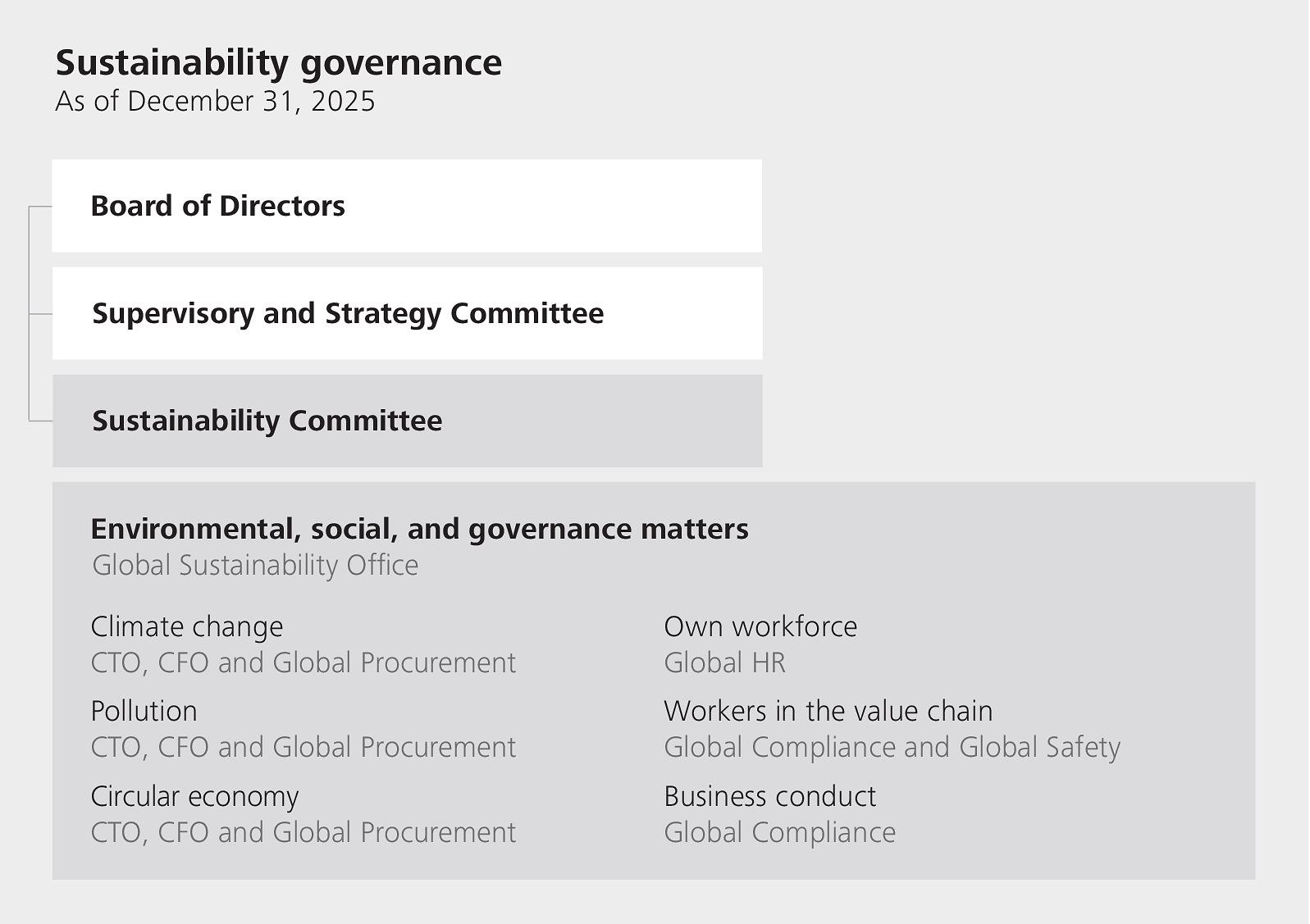
Effective management of Schindler’s nonfinancial risks is built on a robust governance framework, with the Board of Directors and senior management playing a central role in overseeing and managing these risks while ensuring clear responsibility for nonfinancial matters. Additionally, all material topics identified by Schindler have clearly assigned senior management accountability.
Schindler’s Board of Directors oversees, reviews, and approves Schindler’s values and strategy, including sustainability, and receives regular updates regarding the implementation of the Sustainability Roadmap 2030. The Board of Directors also oversees the enterprise risk management process, which includes material nonfinancial risks.
The Group Executive Committee, which is chaired by the CEO and simultaneously forms Schindler’s Sustainability Committee, implements Schindler’s sustainability values. Together with the Supervisory and Strategy Committee, it supervises the implementation of the Sustainability Roadmap 2030 and leads and manages the progress on sustainability, establishing operational targets, driving implementation, and ensuring integration across the business. The Sustainability Committee meets regularly as part of the regular Group Executive Committee meetings.
The CFO leads the annual nonfinancial reporting and is advised by the Global Sustainability Office, which recommends strategies for integrating sustainability into the business, including target setting, progress tracking, and external commitments. Management updates the Board of Directors about climate-related issues and other sustainability-related issues through a structured reporting process. Before approval by the Board of Directors, the Nonfinancial Report is reviewed by the Supervisory and Strategy Committee and the Audit Committee.
As part of their variable compensation, members of the Group Executive Committee and executive members of the Board of Directors receive an annual performance-related cash bonus. In addition, the members of the Group Executive Committee receive a long-term compensation component designed to reward long-term value creation, which includes sustainability criteria linked to the achievement of climate transition plan KPIs, progress towards climate-related targets and achievement of the targets, as well as reduction in absolute GHG emissions (scope 1, 2, and 3).